

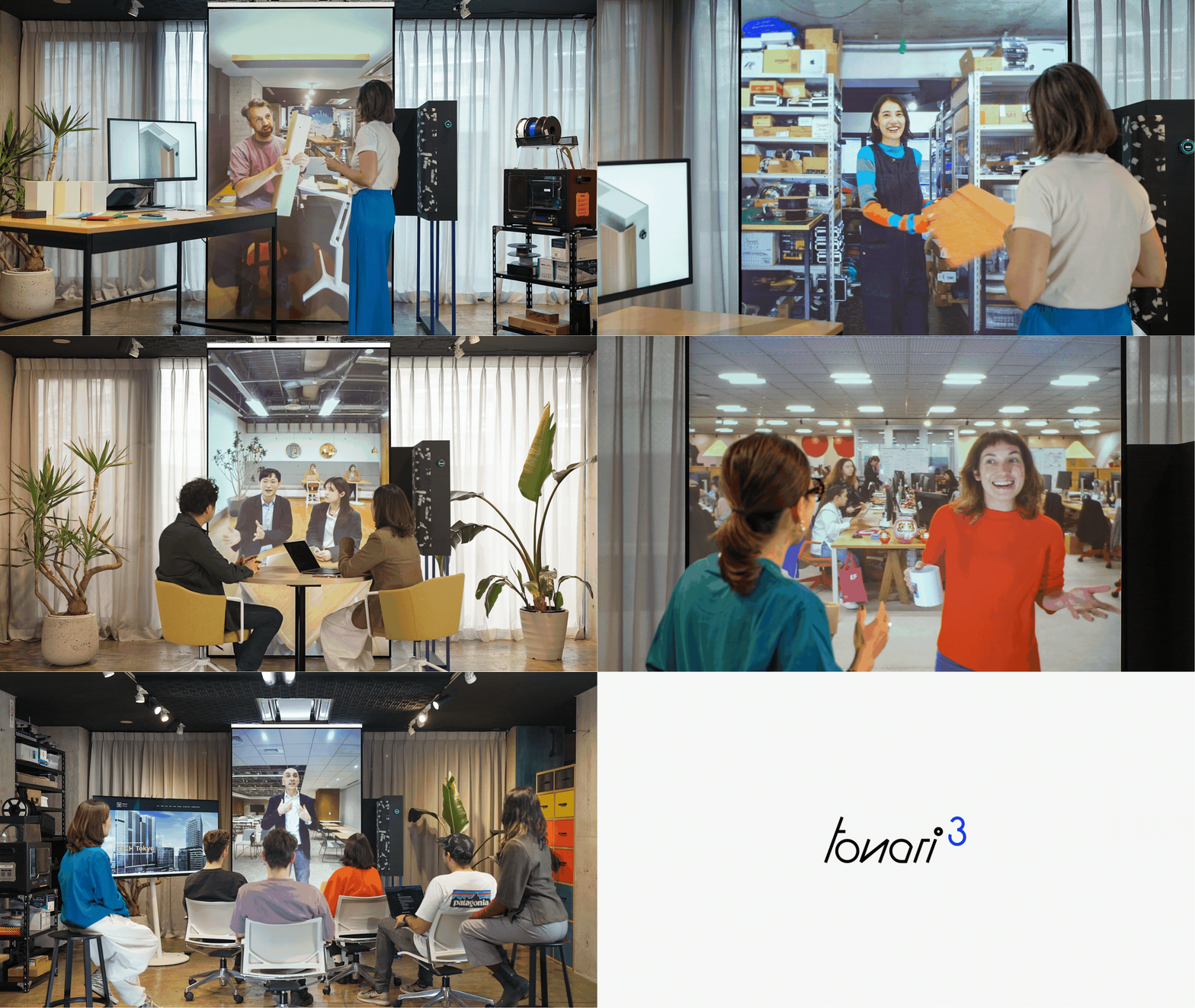

Over the past few years, we’ve seen a similar story play out many times. A team falls in love with tonari portals — life-sized, always-on connections that make two places feel like one — and once their first two or three locations are connected, they want even more. A regional office. A manufacturing site. An overseas branch. Then reality gets in the way. The space they want to use has no spare wall. The site is a remote workshop or factory where internet bandwidth is limited or the network is unreliable. Or the next locations are smaller offices, studios, and teams without the budget or time to manage an installation. Their desire to be together wasn’t the problem. The location, the network, or the cost was.
So today we’re announcing tonari 3, our next-generation portal redesigned from the ground up to remove these barriers. It’s simpler to install, can run on almost any network, and is the most affordable version of tonari ever made.
Why we built a new tonari
Since founding tonari in 2018, we’ve been working to solve the curse of distance: the fact that humans are built to be together, and yet we often live and work apart. We’re now approaching our 100th deployment, with portals installed across 13 prefectures in Japan and 8 countries worldwide, connecting sales teams across Fukuoka, Nagoya, and Osaka, designers between Hanoi and Saitama, and researchers between Tokyo and Harvard.
Along the way, we noticed our conversations with customers shift from whether tonari can really change how one disjointed team collaborates, to how quickly they can bring portals everywhere. Once organizations experience being together through portals, they stop thinking in pairs and start thinking in networks.
The distance problem is bigger than it looks on a map. So much of Japan’s manufacturing, engineering, and design happens outside the big cities — automakers and their suppliers, chemicals, robotics, textiles, semiconductors — and while the Shinkansen makes Tokyo to Nagoya or Osaka easy, reaching a site in a smaller city can still take a full day. Hokkaido or Kyushu usually means a flight. In snowy regions, winter can turn even nearby sites into a slow and dangerous drive. And across Asia the problem repeats at a larger scale: there are no trains or highways connecting countries, so routine work between them runs on airplanes.
Teams everywhere end up choosing between two imperfect options: video calls that are convenient but shallow, or travel that is deep but slow and expensive. We believe portals are the third option: the feeling of being physically present, without the need to move. But that’s only true if a portal can live wherever the work actually happens, and the teams who need this most — smaller companies, rural sites, growing startups — often have the least access to ideal spaces, perfect internet, or big budgets.
So we gave ourselves a simple brief for the third generation: any space, any network, any team.
Any space
tonari 3 can be mounted on a wall, leaned against one, or stand freely in the middle of a room. One big change is the footprint. With the new OLED dial and refined interface, tonari 3 operates fully standalone: the sharing display is now optional, and you can bring your own displays, connected wired or wirelessly. This slims down the portal itself to just 1760mm wide, 2350mm tall, and 625mm deep.
Free-standing setups are simpler and more affordable too: instead of the larger mono structure, tonari 3 uses a smaller weighted “kickstand” that attaches to the base and rear of the unit, and packs easily for shipping and deployment. Setup takes a few hours, and the whole unit can be relocated or serviced with the same ease. This means a portal can now go wherever work happens: workshops, factories, labs, classrooms, clinics, shops, and even homes.
Any network
Until now, tonari has asked a lot of the network it runs on, and a fast, stable, wired internet connection was a hard requirement. With tonari 3, we’re introducing changes that make tonari drastically more robust to different networks including WiFi, 5G, and Starlink, while also using up to 80% less bandwidth than before, which means even more portals can be on the same network. Many wireless connections do come with trade-offs, as they’re more prone to congestion and packet loss, with higher jitter and latencies. But when a wired connection isn’t available — at a temporary site, a rural workshop, an office still waiting on fiber — tonari can now make the best of the connection you have. And none of this comes at the cost of quality: tonari still provides 3K 60fps video, transparent multi-channel audio, and sub-100ms glass-to-glass latency on a good wired or WiFi network, fast enough that conversations feel completely natural.
Any team
tonari 3 is the most affordable portal we’ve ever made, with a starting price around 40% less than the previous generation. This now puts tonari within reach for many more small businesses and startups, and makes it even easier to scale to more locations in large companies. Getting here has taken lots of quiet, behind-the-scenes work: simplifying the hardware, refining materials and manufacturing processes, and designing every part to be easy to repair and reuse. It reflects a lesson we keep learning: the way to make technology feel magical is to make it simpler, and the way to bring it to more people is the same.
From portals to infinite dynamic spaces
Put these pieces together with location hopping, and something bigger emerges: tonari is no longer just a connection between two rooms, but a network of places. Turn the dial, and you’re in San Francisco; turn it again, and you’re with your team in London or Milan. We call this idea infinite dynamic spaces, where any room with a portal becomes a doorway to every other room in your network. The spaces themselves can be reconfigured moment to moment: a quiet corner becomes a project studio in the morning and a classroom in the afternoon, connected to a different place each time.
Some of our customers are already building exactly this. One organization connected sites across Japan, Singapore, Malaysia, and the Philippines into a single always-on campus, where situational awareness has gone up 8x and tonari’s always-on connection sparks more than 200 spontaneous conversations every week. Meanwhile, a hardware startup has connected every room and team across more than six facilities, so that mechanical engineering can be with design, then software, then manufacturing, then electrical, with connections changing from moment to moment as needs and ideas arise.
For these teams, tonari isn’t about scheduled meetings — it’s about co-presence and genuine human connection. Each day, tonari portals facilitate countless casual, unplanned interactions that build trust, pass on skills, and turn distant colleagues into teammates.
An invitation
tonari portals are already at work in railways and telecoms, manufacturers and consultancies, universities and care facilities. With tonari 3, we hope to hear from the customers who've been waiting to bring tonari to the rest of their sites, and from the teams we couldn't reach before: makers connecting designers with fabricators a day's travel away, startup founders splitting time between cities, companies training talent across borders, schools and studios and clinics, and anyone whose organization is more spread out than their sense of togetherness would like. If that sounds like you, we'd love to talk.
As always, the best way to understand tonari is to experience it in person. Please visit our website to learn more about the new model in detail, and contact us to arrange a demo at one of our showrooms. We’d be happy to show you around.

If you enjoyed this and want to learn more about tonari, please visit our website and follow our progress via our monthly newsletter. And if you have questions, ideas, or words of encouragement, please don’t hesitate to reach out at hey@tonari.no. 👋
Find us 💙
Facebook: @heytonari Instagram: @heytonari X: @heytonari